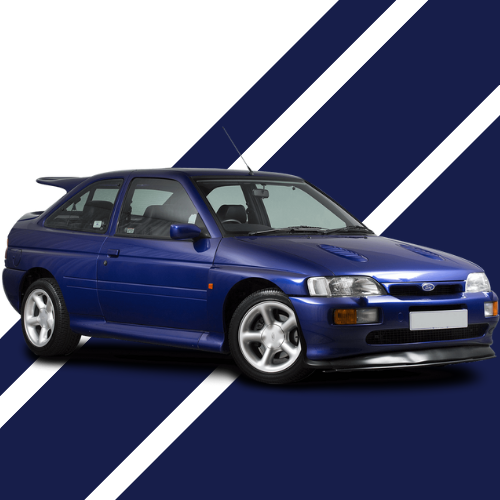
In the annals of automotive history, few cars embody the raw spirit of 1990s performance quite like the Ford Escort RS Cosworth. Nicknamed the “Cossie” by enthusiasts, this turbocharged hot hatch was born out of Ford’s relentless pursuit of World Rally Championship glory. What started as a homologation special—built just to satisfy racing rules—evolved into a poster child for boy racers, a joyride magnet for ne’er-do-wells, and ultimately, a blue-chip investment for collectors. With its whale-tail spoiler, flared arches, and that unmistakable turbo whoosh, the Escort RS Cosworth wasn’t just a car; it was a statement. Let’s dive into its gripping history, blistering performance, and meteoric rise as a classic whose value has soared higher than its top speed. A Storied Heritage: Born for the Gravel Stages. The Escort RS Cosworth’s origins trace back to Ford’s motorsport ambitions in the late 1980s. Ford had tasted success in rallying with earlier Escorts, like the MkI and MkII models that propelled legends such as Hannu Mikkola, Juha Kankkunen, Ari Vatanen, and Stig Blomqvist to victory in the 1970s. But by the late ’80s, the Sierra RS Cosworth was Ford’s weapon of choice in the World Rally Championship (WRC). It was quick, but bulky—hardly the nimble fighter needed to dethrone dominant rivals like Lancia’s Delta Integrale and Toyota’s Celica GT-Four.
Enter Stuart Turner, Ford’s motorsport chief, who envisioned a compact evolution: take the Sierra Cosworth’s proven four-wheel-drive platform, shorten it, and drape it in the sleeker body of the fifth-generation Escort. The result? A car that looked like a pumped-up family hatch but hid the soul of a rally monster. Development kicked off at Ford’s Special Vehicle Operations (SVO) in Boreham, England, during 1990-1992, with final assembly at Karmann in Germany. To qualify for WRC’s Group A class, Ford had to produce at least 2,500 road-legal versions—homologation specials designed more for the track than the Tesco run.
Production began in February 1992, and the first 2,500 “Phase 1” cars featured a massive Garrett T3/T04B hybrid turbo (borrowed from the banned RS200 Group B car) for raw power. These were pure rally mules: no frills, just fury. Later “Phase 2” models (from 1994) swapped to a smaller, quicker-spooling turbo for better road manners, alongside tweaks like improved engine management and a Ferguson MT-75 gearbox replacing the Sierra’s Borg-Warner unit. Special editions added flair—a 128-car Miki Biasion Edition for Italy, 200 Acropolis Editions celebrating a 1993 rally win, and even a prototype Monte Carlo Edition that never saw production.
By 1996, after just 7,145 units built (equivalent to four days of Volkswagen Golf production), the Cossie bowed out, replaced by the Focus RS. But its rally legacy endures. Debuting in 1993, it notched 10 WRC wins through 1997: François Delecour triumphed four times (including Monte Carlo ’94), Miki Biasion grabbed the Acropolis ’93, and privateer Franco Cunico stunned the field at San Remo ’93. Carlos Sainz’s 1997 victories in Greece and Indonesia were its swan song. Though it never clinched a drivers’ or manufacturers’ title—Toyota pipped them in ’93—the Cossie proved reliable, tunable, and ferocious, cementing Ford’s rally DNA.
Performance: Turbocharged Terror on Tarmac and Dirt beneath the Cossie’s aggressive shell—vented hood scoops, bulging wheel arches, and that iconic rear wing generating 19.4 kg of downforce at 180 km/h—lay engineering wizardry. It wasn’t a true MkV Escort; only the doors and roof were interchangeable. The chassis was a shortened Sierra Sapphire 4×4 floorpan, stretched to a 2,552 mm wheelbase for stability. Karmann welded in reinforcements, blending steel panels with polyurethane bumpers and plastic flares for lightweight aggression.
At its heart thumped the Cosworth YBT: a longitudinally mounted, turbocharged 2.0-litre (1,993 cc) inline-four with 16 valves and an intercooler. In standard trim, it delivered 227 PS (224 bhp) at 5,750 rpm and 300 Nm (221 lb-ft) of torque from just 2,500 rpm—enough for a 0-60 mph sprint in 6.1 seconds and a top speed of 144 mph (232 km/h). A viscous-coupled all-wheel-drive system biased 34% to the front and 66% to the rear, with limited-slip diffs fore and aft, made it a grip monster. Brakes were ventilated discs all round (278 mm front, 273 mm rear), shod in 225/45 ZR16 Pirelli P Zeros on 16-inch RS alloys.
On the road, it was a handful: turbo lag meant a split-second pause before the shove, but once spooled, it lunged like a caffeinated greyhound. Car and Driver called it a “go-kart” that hated straight lines until triple digits but turned in with surgical precision.
In rally spec, tuners pushed it to 300 PS or more, as in the Wolf Edition with Bilstein suspension and 300 km/h gauges.
Fuel economy? Forget it—expect 23 mpg on a good day, 12 mpg when hooning. At 1,275-1,370 kg, it was light enough to dance, heavy enough to feel planted. No wonder it starred in Ken Block’s Gymkhana films and even served as an experimental F1 safety car in ’92.
From Boy Racers Dream to Collector’s Grail: The Path to Classic Status
The Cossie’s road life was as colorful as its rally exploits. Priced at around £30,000 new (double a standard Escort), it was a status symbol for ’90s lads with more bravado than sense. Its 227 bhp made it insurably risky—underwriters slapped sky-high premiums on anything GTi-badged in response, earning it a “thuggish” rep.
Joyriders adored it; police loathed it. Yet, beneath the boy-racer stigma lay a car that influenced hot hatches for decades, proving FWD Escorts could birth AWD legends. Today, at over 30 years old, the Escort RS Cosworth is a bona fide modern classic. Its rarity (just 7,145 built) and motorsport provenance have fueled a cult following. Low-mileage, original examples are unicorns—think Diamond White paint, untouched interiors (Recaro seats, Momo wheel, and those triple gauges), and factory stamps on every panel.
Prototypes, like Jeremy Clarkson’s ex-Top Gear eval car (one of three pre-production non-CAT models), or Ken Block’s “Cossie V2” rally tribute, fetch even more.
What elevated it? Nostalgia for a pre-digital era of analog thrills. As evo notes, those who plastered it on bedroom walls are now “old enough and well-heeled enough” to buy one.
Post-2020, demand exploded amid the classic car boom—Group A icons like the Lancia Delta HF are up too, but the Cossie’s Ford badge broadens its appeal.
Maintenance is key: turbo rebuilds (£2,000+), rust in arches, and chassis checks are musts, but a well-kept one drives like new.
The Value Surge: From £20k Bargains to £200k Masterpieces
When production ended in 1996, used Cossies dipped to £10,000-£15,000 by the early 2000s—affordable for enthusiasts, but many were thrashed. Fast-forward to 2025, and appreciation has been stratospheric. Average sale prices now hover at £60,568, with pristine homologation specials pushing £100,000+.
The pinnacle. A 1992 Diamond White example with 2,221 miles sold for a record £202,500 at Iconic Auctioneers’ 2024 NEC sale—nearly 10x a new Mustang Dark Horse, from a private collection untouched for 30 years.
Why the boom? Scarcity meets sentiment. With fewer than 5,000 survivors (estimates vary), and rising interest from US collectors via imports, supply can’t match demand. Non-homologation “Lux” models average £60k, but Phase 1 turbo variants command premiums. As one auctioneer put it, it’s “hot property” alongside Delta Integrales.
Expect 10-15% annual appreciation for gems—better than stocks, with better stories.Revving into the Future:
Why the Cossie Still Captivates
The Ford Escort RS Cosworth transcends its era. It was Ford’s last great rally homologation hurrah before regulations shifted, a bridge from the wild Group B days to the WRC’s golden age. For drivers, it’s therapy: that turbo spool, the AWD grip, the sheer audacity of a family hatch gone feral. For investors, it’s a hedge against the ordinary—low production, high pedigree, endless tunability. If you’re hunting one, prioritise history: full service logs, original panels, and a PPI for hidden gremlins. Drive it like you stole it (legally, of course), but sparingly. The Cossie isn’t just surviving, it’s thriving, proving that sometimes, the best classics are the ones that were built to break rules. What’s your take—dream garage staple or missed investment? Drop a comment below.